Human-readable identity
The card uses portrait, name, date of birth, place of origin, signature, document number, and official naming to behave like a real identity document.
A sovereign trust object for physical identity, digital verification, and FC Chain certified residency infrastructure.
一个把实体身份证件、数字身份认证、FC Chain 验证和 Montserrat 国家叙事统一起来的设计说明册。
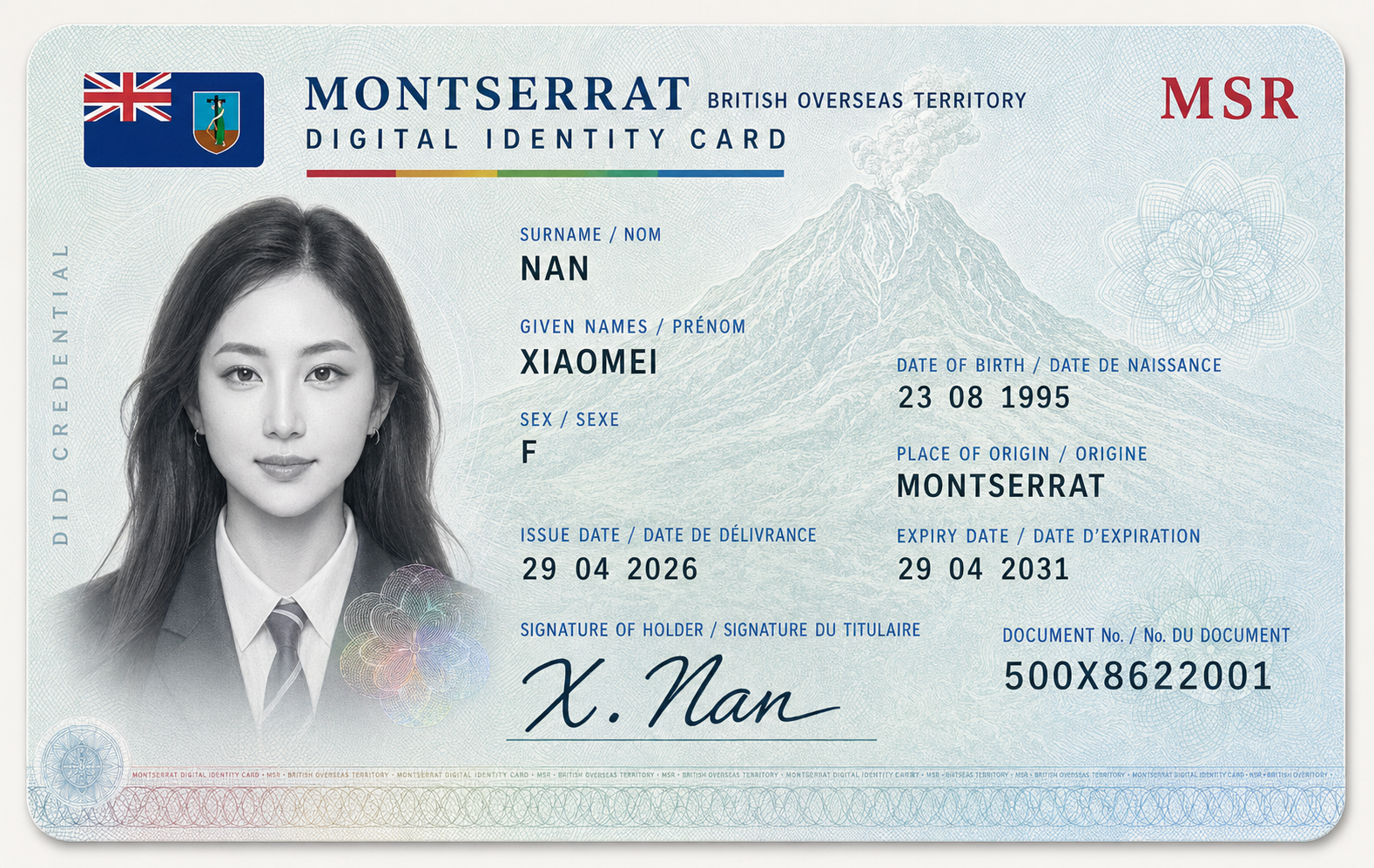
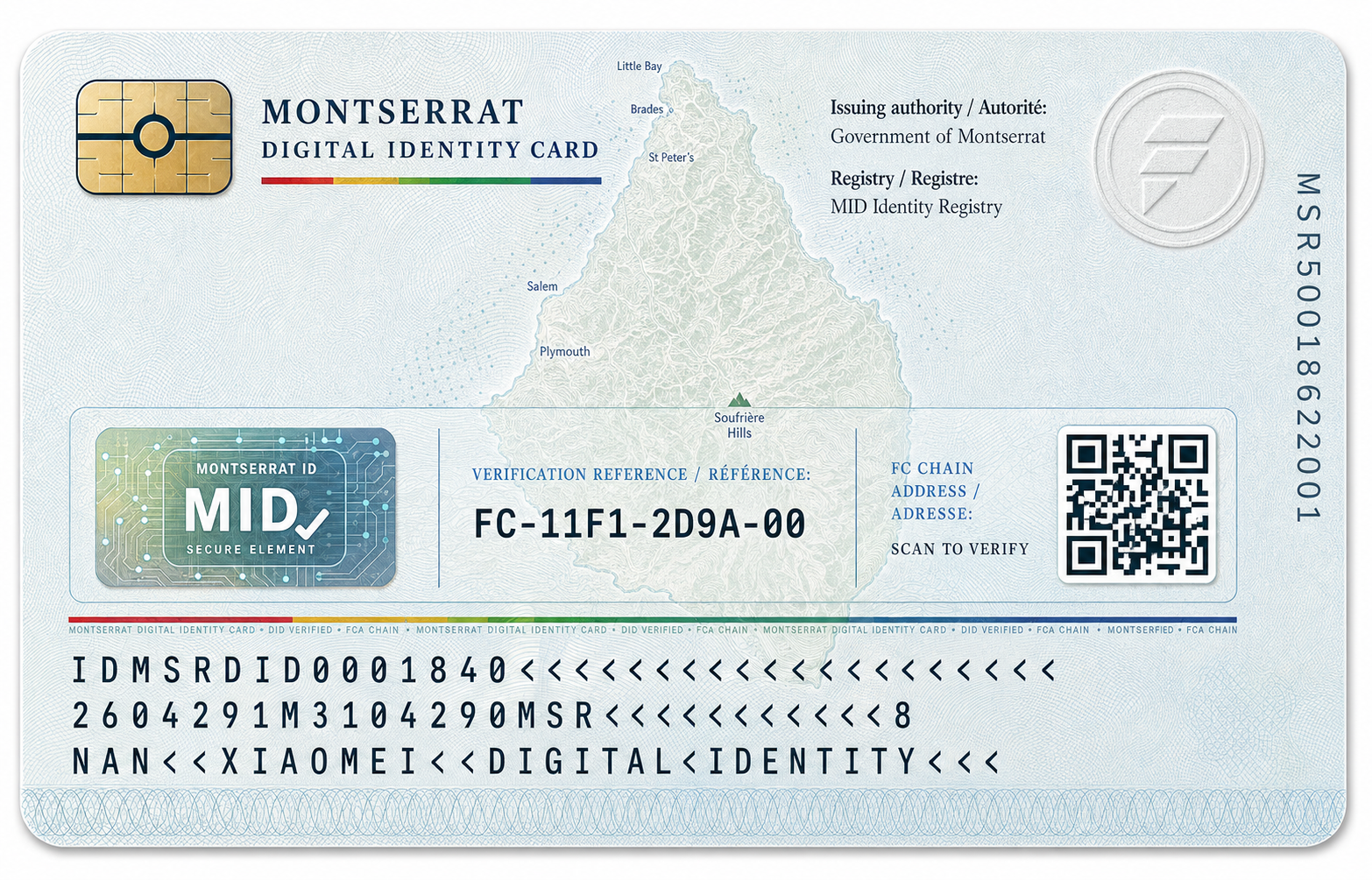
This brochure follows the style of an official identity-card presentation: first the public value, then the design language, then the security and verification architecture.
本手册按正式身份证件介绍册的逻辑组织:先说明价值,再说明设计故事,最后说明安全元素、数字验证和交付检查。
The Montserrat Digital Identity Card is designed to make MID visible in the physical world while keeping FC Chain verification available in the digital world.
The card uses portrait, name, date of birth, place of origin, signature, document number, and official naming to behave like a real identity document.
QR, MRZ, serial logic, and the FC Chain reference give systems a clear way to verify the credential without crowding the front of the card.
Volcanic relief, island cartography, Montserrat flag, MSR mark, and Caribbean security-paper colours turn the card into a sovereign object.
The physical card connects MID, M Wallet, identity verification, future services, and FC Chain certification in one coherent object.
The card should feel more like an official European-style identity card than a membership card, app credential, or crypto badge. Web3 technology is present, but it is expressed through disciplined document design.
设计原则:让实体卡看起来像正式身份证件,而不是会员卡、App 截图或 Web3 徽章。技术存在于背后的验证系统里,视觉上应当克制、可信、精致。
The visual system is built around Montserrat's volcanic geography, island outline, national flag, and the clean security-paper language used by contemporary identity cards.
视觉系统围绕 Montserrat 的火山地形、岛屿轮廓、国旗和现代身份证件常见的安全纸纹理展开。
The volcano is the emotional centre of the front side. The island map is the geographical centre of the reverse side. The FC Chain watermark, QR code, and MID secure element add the machine-verifiable layer without weakening the national tone.
Used on the front as a quiet, detailed image layer. It gives the card a landscape signature and avoids generic digital decoration.
A compact territory signal. It should be simple, direct, and physical-document-like, not enclosed in a decorative badge.
Placed as an engraved watermark on the reverse side, communicating the verification layer without overpowering the document.
The QR code resolves to the DID / FC Chain address and belongs on the reverse side near the machine-readable layer.
The portrait should blend into the security-paper background instead of sitting inside a hard app-like frame.
The MRZ makes the reverse side feel like a real travel or identity document and gives the card a disciplined base line.
1
2
3
4
5
6
7
8
9
10
1
2
3
4
5
6
7
8
9
10
The card concept uses visible, tactile, optical, machine-readable, and digital cues. These are design specifications for the concept stage and should be validated with production partners before final manufacture.
Fine security-paper texture, volcanic linework, island topography, and micro-text bands give the card visual depth.
Subtle rosette and light-shift effects should overlap the portrait and document surface without looking like app decoration.
The document number, vertical serial, MRZ band, and scan area must not collide and must remain readable.
The QR code points to the DID / FC Chain verification address and should reveal validity without exposing unnecessary personal data.
Use "cryptographically verifiable" in the brochure and team documentation. Avoid putting long disclaimers or technical caveats on the physical card itself.
建议在手册中解释“可加密验证”,不要把冗长免责声明或技术说明放到卡面上。
The QR code is the public bridge between the card and the digital registry. The card holder shows the physical credential; the verifier scans the QR code and checks the DID status against FC Chain.
The holder presents the Montserrat Digital Identity Card in a physical or remote flow.
The verifier scans the QR code on the reverse side.
The QR resolves to the FC Chain DID or verification address.
The system checks validity, registry reference, and revocation status.
The QR should not behave like a marketing link. It should be treated as a verification endpoint with a clear DID reference, issuing authority, status, and timestamped registry result.
The MID secure element is the physical-design expression of the identity layer. It should be placed on the reverse side near the FC Chain verification reference, supported by the contact chip and MRZ band.

Visual symbol for the holder's MID credential and card-based identity system.
Gold-metal and deep-blue circuit styling should harmonise with the FC Chain mark.
Short reference values can support operational lookup without crowding the front.
The card should stay focused. It should include only identity, issuance, registration, verification, and machine-readability fields that support the document's purpose.
The card is a shared product. It needs product, design, government, engineering, security, registry, and production teams to work from the same source of truth.
Define the credential purpose, holder journeys, registry rules, and how the card appears inside M Wallet.
Define eligibility, field rules, issuance status, expiry policy, verification response, and revocation process.
Maintain the official visual language, national motifs, portrait integration, and production-ready layouts.
Build DID resolution, QR verification, audit trail, wallet display, and status checks.
Review physical card elements, data minimisation, scan flows, key management, and fraud resistance.
Validate print, chip, tactile, holographic, and machine-readable features before sample approval.
Turn this brochure into a production review pack: final front and back artwork, security element map, QR verification specification, MRZ data rules, issuer approval checklist, and sample-card QA sheet.
下一步可以把本手册升级为生产评审包:正反面终稿、防伪元素图、QR 验证规格、MRZ 数据规则、签发方审批清单和样卡质检表。